Quick answer
A furnace blower plus a fridge, lights and Wi-Fi usually needs about 2,000–2,500 running watts. Add a 1/2 hp sump pump and you’re in 3,000+ running watt territory. A 2,500W inverter handles a fridge plus essentials or a furnace blower; a 4,000W-class unit (about 3,200 running watts) can handle all three if you start them one at a time.
Typical wattage chart
| Appliance | Running watts (approx.) | Starting watts (approx.) |
|---|---|---|
| Furnace blower, 1/3 hp | 700 | 1,400 |
| Furnace blower, 1/2 hp | 875 | 2,350 |
| Sump pump, 1/3 hp | 800 | 1,300 |
| Sump pump, 1/2 hp | 1,050 | 2,150 |
| Refrigerator | 700 | 2,200 |
| Well pump, 1/2 hp (often 240V) | 1,000 | 2,100 |
| Wi-Fi router + modem | 25 | — |
| LED lights (5 bulbs) | 50 | — |
| Space heater | 1,500 | — |
These are conservative planning numbers from common generator wattage charts. Newer appliances (especially ECM furnace blowers and modern fridges) often use less. Your appliance nameplate or manual is the real number.
How to size it in 3 steps
- List what must run at the same time — for example fridge, furnace blower, sump pump, Wi-Fi and a few lights.
- Add their running watts. Example: 700 + 700 + 1,050 + 25 + 50 = about 2,525 running watts.
- Add the biggest extra starting surge (starting minus running for your largest motor). The 1/2 hp sump adds 1,100, so you need about 3,600 starting watts. Start motors one at a time.
Leave about 20% headroom so the generator isn’t running flat out for hours.
Furnace-specific notes
Hardwired. Furnaces are wired into your panel, so you can’t just plug them into a generator. In Ontario you need a transfer switch or approved interlock installed with an ESA permit. See connecting a generator safely in Ontario.
Clean power. Furnace control boards can be fussy about generator power. Inverter generators produce low-distortion power that electronics prefer; your electrician or HVAC technician can confirm compatibility.
Sump pumps. A battery backup sump pump is a good add-on, but a generator covers longer outages. Many sump pumps plug into an outlet, so a heavy-duty outdoor extension cord from the generator can work.
Generators by size Imported alternative
| Photo | Product | Type / size | CAD price | Rating | Best for | Shop |
|---|---|---|---|---|---|---|
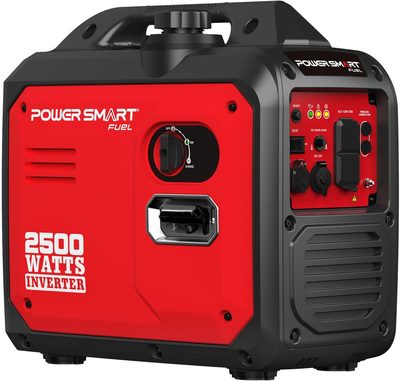 |
PowerSmart 2500W inverter Imported · budget |
Gas inverter · 2,500W starting / 1,900W running | $386.99 CAD | Fridge + essentials on a budget | PowerSmart 2500 — $386.99 CAD · 4.5★ (1,211) · Ships from Amazon | |
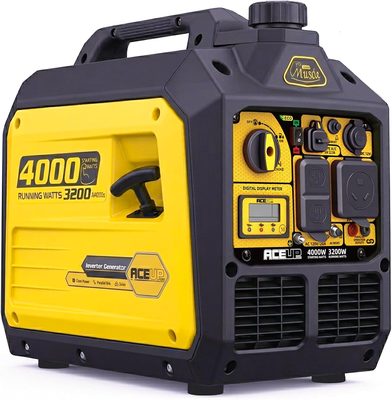 |
Aceup 4000W gas inverter Imported alternative |
Gas inverter · 4,000W starting / 3,200W running | $542.99 CAD | More headroom for a sump pump or furnace blower | Aceup 4000 gas — $542.99 CAD · 4.6★ (393) · Ships from Amazon | |
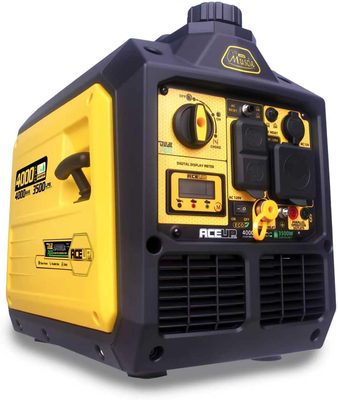 |
Aceup 4000W Dual Fuel Imported alternative |
Dual-fuel inverter · 3,200W gas / 3,000W propane running | $650.99 CAD | Propane backup when gas stations are closed | Aceup Dual Fuel — $650.99 CAD · 4.6★ (393) · Ships from Amazon |
Aceup 4000 gas — $542.99 CAD · 4.6★ (393) · Ships from Amazon
Imported · budgetPowerSmart 2500 — $386.99 CAD · 4.5★ (1,211) · Ships from Amazon
Prices, star ratings and review counts were checked on Amazon.ca on Sep 18, 2026 (ET) and can change. Products marked Imported alternative are not made in Canada.
FAQ
What size generator do I need to run a gas furnace?
A gas furnace blower typically needs about 700–900 running watts and up to about 2,350 starting watts. A 2,500W inverter can usually run the furnace with a few lights; add other loads and you’ll want a 4,000W-class unit.
What size generator runs a sump pump?
A 1/3 hp sump pump needs about 800 running and 1,300 starting watts; a 1/2 hp pump about 1,050 running and 2,150 starting. A 2,500W inverter can handle one pump plus small loads.
Can one generator run my furnace, fridge and sump pump?
Yes, if it has about 3,000+ running watts and you start the motors one at a time. A 4,000W-class inverter rated around 3,200 running watts is a common fit.